


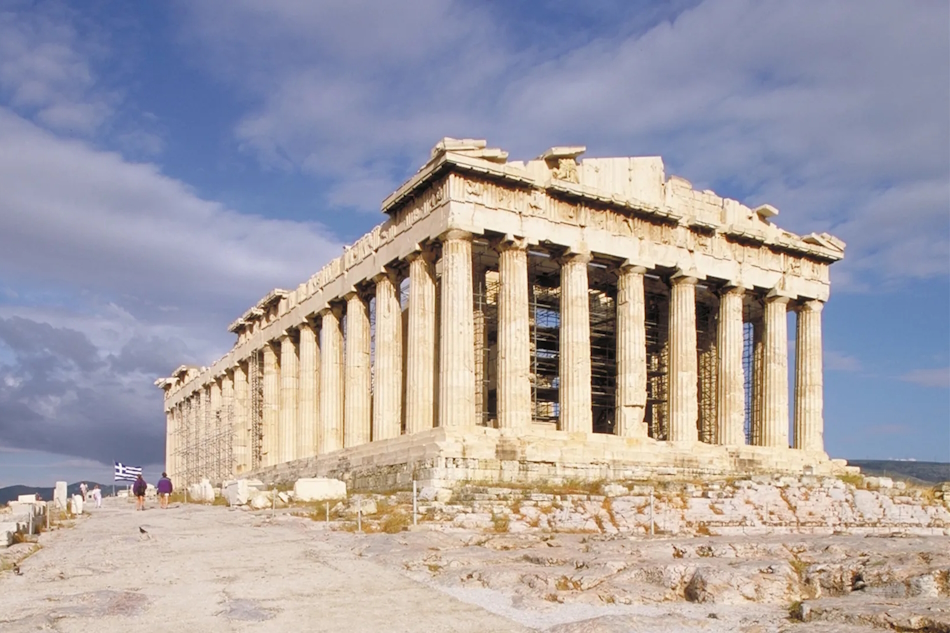
Greece, the southernmost country on the Balkan Peninsula, has been strongly influenced by its geography.
Mountains have historically limited internal communication, while the sea has opened up wider horizons. The total area of Greece (of which one-fifth are Greek islands) is comparable to the size of England or the US state of Alabama. Greece has more than 2,000 islands, of which approximately 170 are inhabited; some of the easternmost islands of the Aegean Sea are only a few miles from the Turkish coast.
Read also:
Which of the Cyclades islands in Greece should you visit?
Santorini – Island of beautiful sunsets and white architecture
Greece – Land of gods and countless islands
The country’s capital is Athens, which expanded rapidly in the second half of the 20th century. The area around the capital, Attica (ancient Greek: Attika), is now home to about one-third of the country’s total population. It is a country that is European, Balkan, Mediterranean, and Middle Eastern all at once. It lies at the crossroads of Europe, Asia, and Africa and is heir to the legacies of classical Greece, the Byzantine Empire, and nearly four centuries of Ottoman Turkish rule.
Greece is bordered by the Aegean Sea to the east, the Mediterranean Sea to the south, and the Ionian Sea to the west. Only in the north and northeast does it have land borders (totaling about 1,180 km) with Albania, North Macedonia, Bulgaria, and Turkey. The Greek landscape is striking not only for its rugged beauty but also for its complexity and diversity. Three elements dominate: the sea, the mountains, and the plains.
The Greek mainland is very rugged; bays and sea inlets penetrate so deeply that only a small part of the interior is more than 80 km from the coast. Rocky capes and peninsulas jut out into the sea, where there are many island arcs and archipelagos. The southernmost part of mainland Greece, the Peloponnese peninsula, is connected to the mainland by only a narrow isthmus at the head of the Gulf of Corinth. Mountainous terrain covers about four-fifths of the country, much of which is deeply indented.
A series of mountain ranges on the mainland, oriented from northwest to southeast, surround narrow parallel valleys and numerous small basins that once contained lakes. Together with river valleys and thin, discontinuous strips of coastal lowlands, these inner valleys and basins form the lowlands. Although it makes up only about one-fifth of the country’s territory, the lowlands have played an important role in the life of the country.
The geographical and geological characteristics of Greece provide the basis for describing the Greek landscape in terms of six main regions: central, northeastern, eastern, southern, and western mainland Greece, together with the islands.