


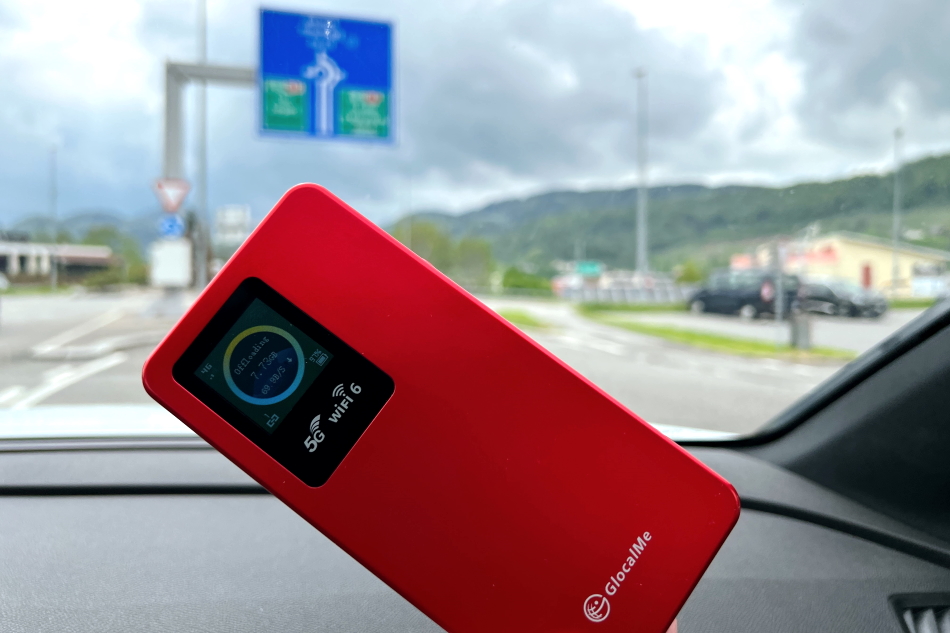
We tested a practical solution for frequent travelers.
SIM cards are a real nuisance when traveling, but there is an easier way. A common problem for travelers is that when they arrive at a new destination outside the EU, they have to go through the same “procedure” and everything that goes with it.
After landing at the airport, they can try to buy a seemingly “cheap” SIM card on the spot, look for SIM card shops elsewhere, or travel to their destination without any connection. This is where a practical solution comes in: buying an international SIM card.
With a SIM card equipped for international travel, users don’t have to worry about a thing. Everything is already set up. Just insert the SIM card into your smartphone and start using it right away.
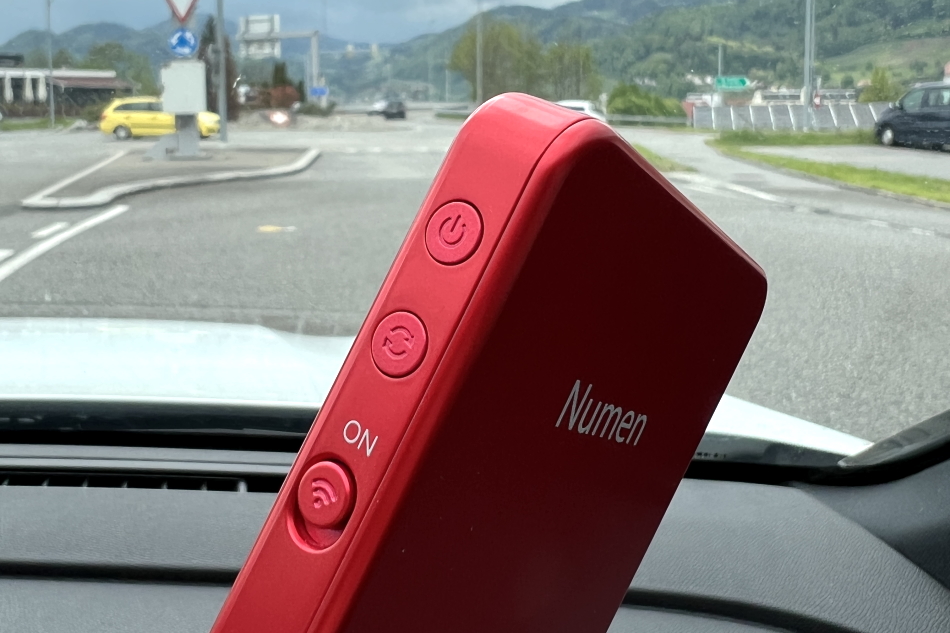
We have found the TravelSIM concept to be very good, with a wide range of offers, support, and options. If you are traveling with your family, a shared hotspot is a good solution, such as the GlocalMe Numen we tested.
The advantage of the tested hotspot is its support for the latest fifth-generation mobile networks – 5G. 4G LTE networks are better than ever, and with the launch of 5G networks around the world, wireless internet surfing could be even faster.
Most smartphones have a hotspot mode, but mobile modems and Wi-Fi hotspots have historically been the best and most flexible option if the user has multiple devices, such as within a family or group of friends on vacation.
In addition to smartphones, tablets and laptops (or virtually any Wi-Fi-enabled device) can also be connected to these mobile hotspots.
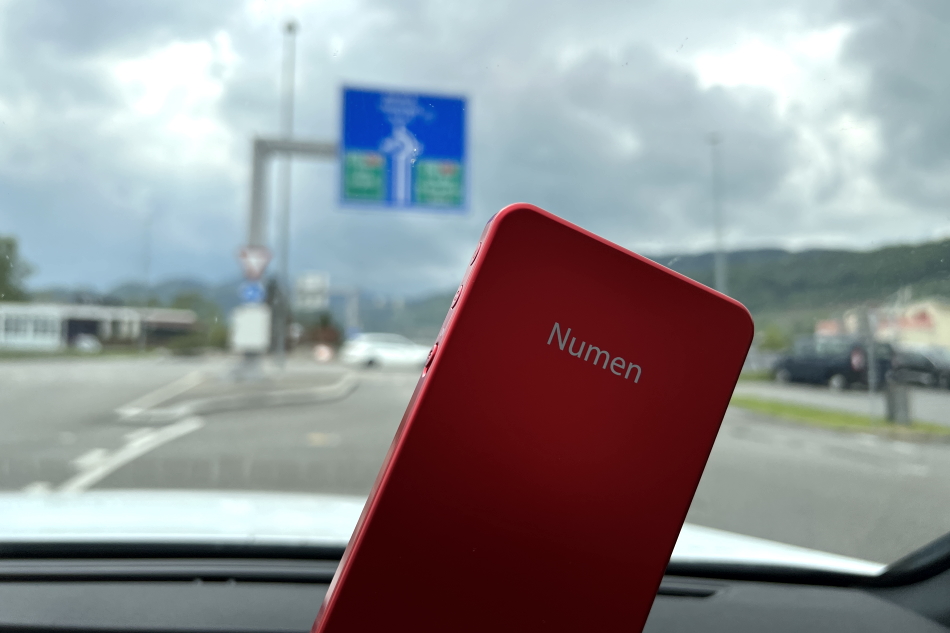
They support more devices at once than the hotspot mode on a phone, do not drain the phone’s battery, and can be connected with better antennas than those available on a phone. They can also have a separate data subscription, which is especially useful when traveling outside the EU, where Eurodata roaming does not apply.
A portable hotspot can save a lot of money compared to mobile phone roaming charges. It also eliminates the problem of data limits when traveling, and families and friends can share one connection instead of buying a SIM card for each user.
It allows easier access when traveling in Europe (outside of Euro Roaming) or on vacation outside of Europe. The hotspot also saves mobile phone battery life (compared to using a mobile phone as a hotspot).
The device allows you to connect your laptop, tablet, or any Wi-Fi device to the internet. Since we need the internet wherever we are, it’s very nice to have it with us everywhere.
This means you no longer have to rely on notoriously weak, slow, and, above all, unsecure Wi-Fi networks in hotels, cafes, or shops. We definitely appreciate that the hotspot has a so-called “cloud SIM card” (as the manufacturer calls it).
This is essentially an eSIM card, which gives the device its own IMEI and allows it to be assigned directly to a previously registered account with the provider. Before purchasing this mobile hotspot, you need to create an account and purchase data packages, which can then be used abroad.
In addition, the hotspot also has a slot for one physical SIM card (nanoSIM format). After inserting it, the user can choose directly in the self-service app (which we recommend downloading) whether they want the data to be drawn from the cloud (eSIM) card or from the inserted SIM card.
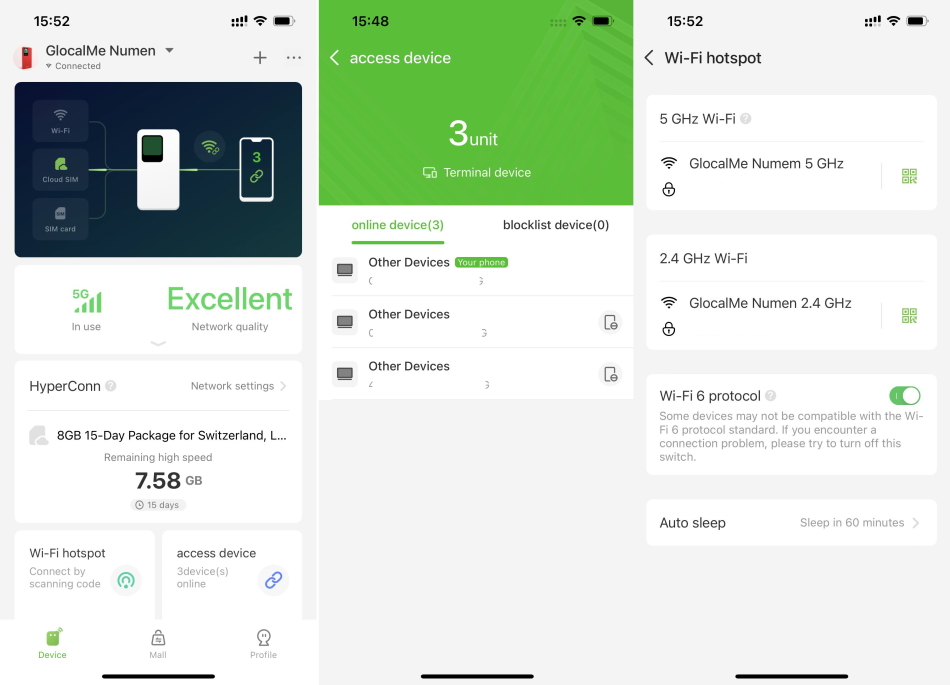
The app also allows you to set a Wi-Fi network password, restrictions (such as restrictions on downloading data, games, etc.), view the current status of purchased packages, their balances, network type (5G or 4G) and quality.
On our trip to Switzerland, we had 2× 8GB data packages for Switzerland and Liechtenstein, as well as 1× 8GB package for Europe/Asia. We also had a TravelSIM SIM card with packages on the SIM card that could be activated if necessary.
We like the automatic network and country recognition. While we were still on the Austrian network at the Austrian-Swiss border, data was drawn from our European data allowance, even though we had set the “Switzerland” package as our priority.
This changed after we logged into the Swiss operator Salt’s network. The remaining volume in this data (EU) stopped and automatically switched to the data package for Switzerland.
The hotspot continuously showed us data consumption, remaining volume, battery percentage, and the number of connected devices. If the user did not notice, a notification appeared when the remaining volume reached 1.6 GB (almost one minute before the package expired). Once we used up the first package, the second one started to be used without any additional settings.
This applies provided that the user has sufficient data or packages. If there are no additional data packages purchased in the account, either the internet will stop, or if there is at least some balance (“Balance”) in the registered account, the internet will be used according to consumption (pay-as-you-go, according to the price per megabyte).
The GlocalMe app is available for iOS or Android. It allows you to add data, monitor usage, and track battery life. The price of the data package depends on the specific location and the amount of data the user needs.
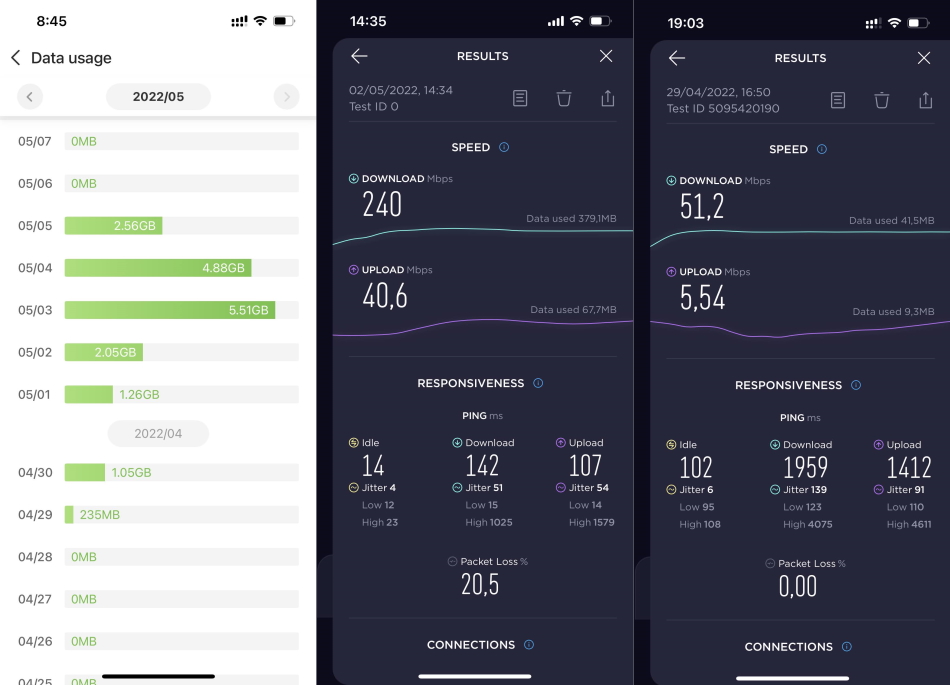
Although the provider states on its website that the 5G network is available in Germany, France, and the UK, for example, we found several places in Switzerland where the 5G network worked without any problems.
It seems that when selecting networks, the provider relies on the cheapest (or most affordable) networks, which in Switzerland means choosing the operator Salt. We did not have the option of Swisscom, which has the best and fastest networks.
Nevertheless, we were able to surf at 5G speeds of 235/39 Mbps in the village of “Au” in the canton of St. Gallen shortly after crossing the Lustenau/Au border crossing between Austria and Switzerland. Zurich also had very good 5G coverage, where we achieved speeds of 240/41 Mbps on the 5G network.
In other areas where the 4G network was available, we achieved speeds of 51/6 Mbps, which is less and similar to the transfer speeds we have in our country with 4ka, for example. How is the battery life of the built-in 3900 mAh battery in the GlocalMe Numen Wi-Fi hotspot?
With three devices connected at once, we achieved a battery life of around 7-9 hours, which we consider very good. Of course, it also depends on the number of connected devices and how much data the user downloads.
Interestingly, travel SIM cards and services are cheaper than roaming data. For example, Telekom offers the following data packages in Zone 2, which includes Switzerland: Package S (100 MB) for €2.50, M (500 MB) for €8, and L (1 GB) for €12, all valid for 30 days.
GlocalMe has lower prices for Switzerland and Liechtenstein, but with different validity periods. The smallest 500 MB package costs €3 (€5 cheaper), but is only valid for one day.
There is also a 1GB package for 7 days for €5 (€5 less) or a 1GB package for 30 days for €9.50 (still €2.50 cheaper than roaming). For heavy data users, GlocalMe offers the largest package of 25GB for 30 days for €31.
The 8GB package for 15 days that we tested costs $20, so for two packages, the user pays $40. With roaming, however, they would pay up to 16 times $12 (since they would have to buy 16 1GB packages, and the operator does not offer a larger and more advantageous package than 1GB).
This means a practically unbelievable difference in price: 16GB of data for $40 via GlocalMe, or $192 when purchasing 16 1GB “L” roaming packages. GlocalMe Numen is a very interesting concept for a Wi-Fi hotspot device with practical features.
Perhaps the only drawback is the high price of the device, which is up to €500, which is more than we would expect. This is probably the price you pay for the advanced concept of the device, as a classic hotspot does not offer users as many features.
The built-in “cloud” (eSIM) card with the option of adding a physical SIM card, which can be easily “managed” directly in the app, practical and interesting features, as well as an interesting concept, make this hotspot a welcome accessory for frequent travelers. We recommend it because of its many features and the money you save compared to buying data packages.