


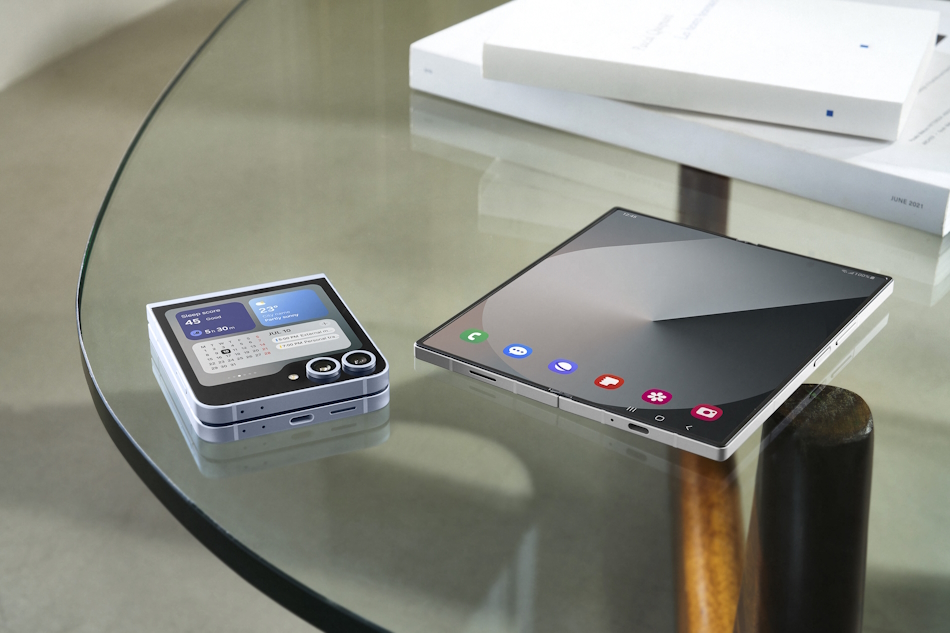
This year’s successors are the Z Fold 6 and Z Flip 6.
The first one, the Z Fold 6, comes with a new aspect ratio and lower weight. It is a thinner and lighter foldable phone with new aspect ratios for both displays.
It is equipped with a Qualcomm Snapdragon 8 Gen 3 for Galaxy chipset along with Android 14 and One UI 6.1.1, and the latest artificial intelligence features – Galaxy AI. The most important change brought by the Fold 6 is the new, slightly different aspect ratio of its outer (cover) display. It’s still not what you would call conventional, but the 22.1:9 ratio is significantly better than the 23.1:9 of the previous model.
The diagonal of the outer display has also been slightly increased to 6.3″, which, combined with the new aspect ratio, means a decent increase in size at the expense of the bezels. Overall, it is 1.5 mm shorter and 2.9 mm wider when unfolded (1 mm in folded state) compared to last year’s model. It is also 0.5 mm thinner when unfolded (1.3 mm when folded), but more importantly, it is 14 grams lighter than its predecessor. In fact, weighing 239 grams, it is close to the lightest foldable phones and is also only 7 grams heavier than the S24 Ultra.
The hinge has also been redesigned, and the manufacturer has even placed a 1.6× larger vapor chamber compared to the Fold 5 to further improve heat dissipation. The Fold 6 is also IP48 certified – dust protection is a first among foldable phones. Of course, it only guarantees protection against solid particles larger than 1 mm, but that’s still better than anything we’ve had so far. Inside is a 7.6″ foldable (or Infinity Flex, as the manufacturer calls it) display with an aspect ratio of 20.9:18.
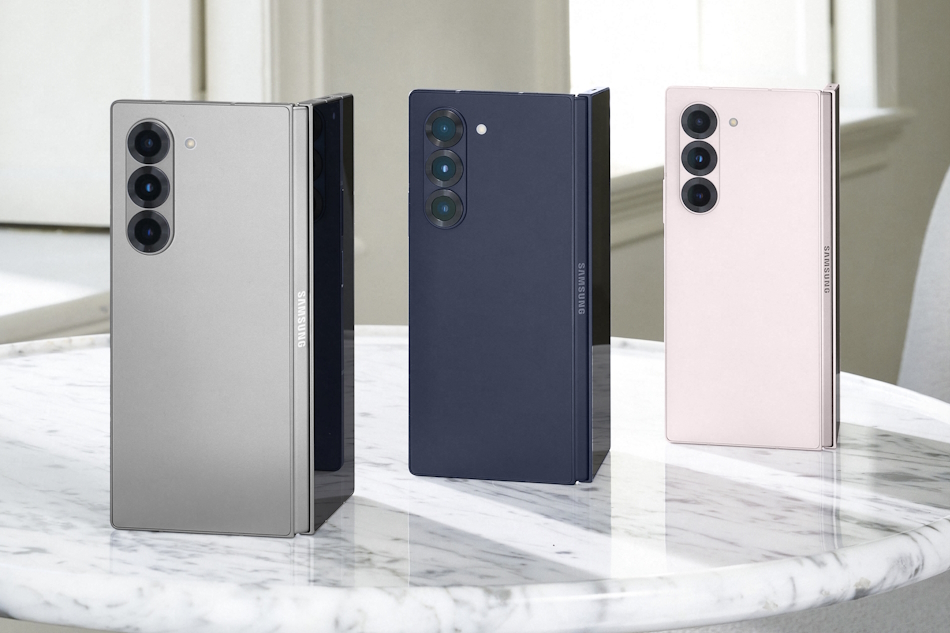
In the photo: Samsung Galaxy Z Fold 6
Both the main and external displays are Dynamic AMOLED 2X with an adaptive refresh rate of 120 Hz. The cover display and the back of the phone (when folded) are protected by Corning Gorilla Glass 2. The five cameras in the Z Fold 6 don’t bring many hardware improvements. It still has a 50 MPx f/1.8 main sensor with OIS on the back, along with a 10 MPx f/2.4 telephoto lens with 3× optical zoom and a 12 MPx f/2.2 ultra-wide-angle lens with a 123° field of view.
The 10 MP selfie camera is located in a hole in the cover display, while the 4 MP video chat camera is hidden under the foldable display. Disappointingly, for the third time in a row, the flagship foldable phone comes with a 4400 mAh battery that supports 25W wired, 15W wireless, and 4.5W reverse wireless charging. However, the company promises that improved efficiency will extend the battery life between charges.
Samsung has talked at length about the advances of Galaxy AI, touting the Z Fold 6’s large screen for productivity. Note Assist and Circle to Search are carried over, but new features in One UI 6.1.1 based on Android 14 take advantage of the foldable format. Interpreter mode allows both parties to see translations on the main (inner) and outer displays, while Sketch to Image lets AI generate sophisticated art from sketches made in the Gallery or on the Note screen.
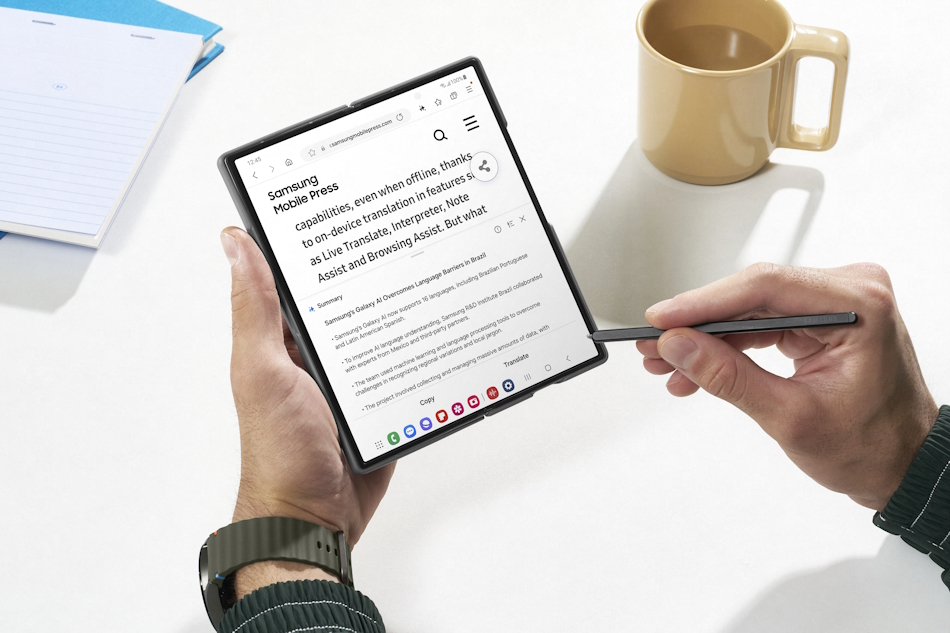
In the photo: Samsung Galaxy Z Fold 6
The Z Fold 6 comes with three storage options — 256GB, 512GB and 1TB — all paired with 12GB of RAM. The main color options include gray, pink, and blue, with exclusive colors (carbon black and white) available only through Samsung’s online store. Prices in Europe start at €1,999 for the 256GB version, with the 512GB and 1TB versions costing €2,120 and €2,360 respectively. In the US, pricing starts at $1,899. Pre-orders are available starting July 10, with devices available for purchase on July 24, 2024.
Foldable phones, suitable for users who don’t like large “bricks,” will appreciate the newly introduced Flip 6. The most notable feature is the improved 50 MP camera (up from the original 12 MP sensor) and an updated processor. The Flip 6 is thinner, lighter, more durable, and smarter than its 2023 predecessor and gets a significant upgrade to its camera system.
The phone is powered by the Qualcomm Snapdragon 8 Gen 3 for Galaxy chipset, regardless of which market we are in. The chipset’s computing power is used for various AI tasks and (for the first time on the Z Flip) heat is regulated by a vapor chamber. In addition, the phone now comes with 12GB of RAM (up from 8GB last year) and 256GB or 512GB of storage.
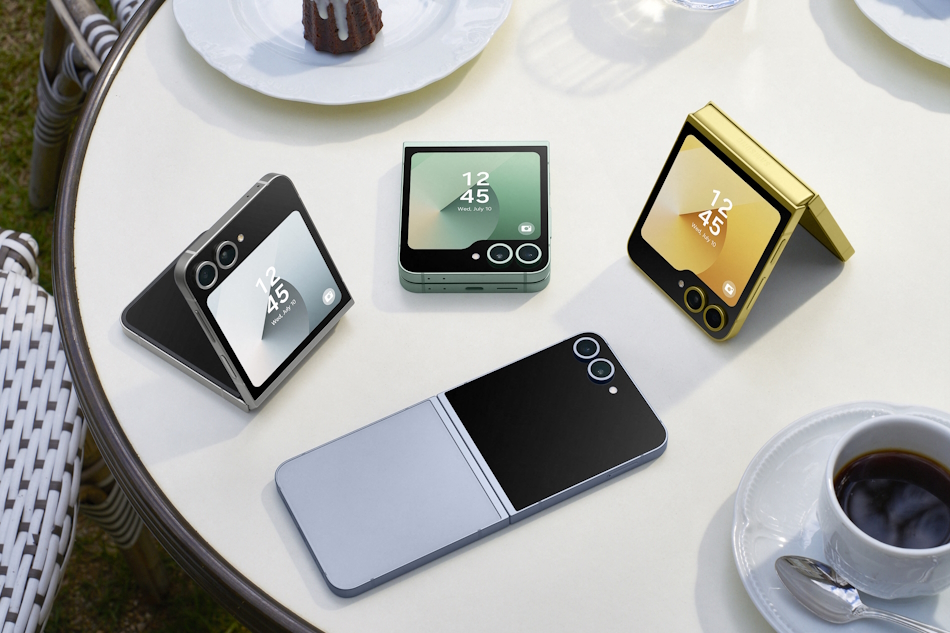
In the photo Samsung Galaxy Z Flip 6
The main camera has been upgraded to a 50 MPx sensor (f/1.8 85° lens with OIS), which provides 2× in-sensor zoom. It can be zoomed in even further with AI zoom, which achieves up to 10× magnification. The 12 MPx ultra-wide-angle sensor (123°) remains unchanged, as does the 10 MPx selfie camera (1.22µm, 85°). The main display is now an LTPO panel (1-120Hz), but retains the same 6.7″ diagonal and Full HD+ resolution. The Flex display is the same size and resolution as before, 3.4″ 720×748px, and still runs at 60 Hz. It can reach 1600 nits in high brightness mode.
Auto Zoom is an AI-powered feature for Flex Mode (i.e., when you use the phone half-folded to act as its own tripod). The feature automatically zooms in and out to get the best framing of the shot without direct user control, enabling touchless group photos. Nightography has been expanded to support HDR video. Advanced image processing features are available directly in the Instagram app.
Other AI features also take advantage of the Flex Display, such as Suggested Replies, which analyzes the user’s recent messages and suggests a response to incoming messages so they don’t have to open their phone or type with it closed. It can also display notifications from Samsung Health. New widgets have been added for even more customization, and multiple widgets can be displayed at once.
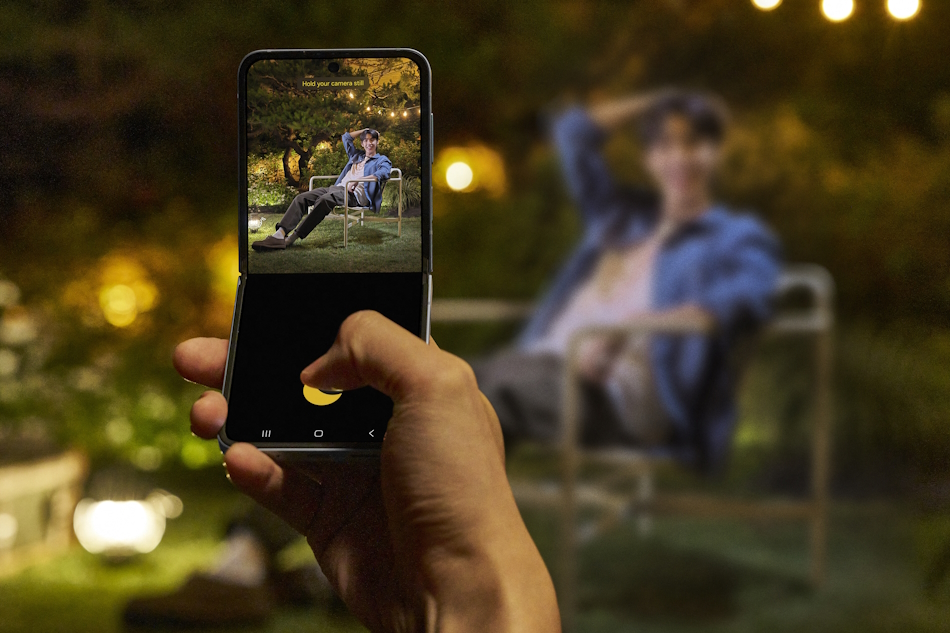
In the photo: Samsung Galaxy Z Flip 6
The manufacturer has further optimized the hinge to achieve a thinner profile when the phone is closed. The Z Flip 6 measures 85.1×71.9×14.9 mm when closed and 165.1×71.9×6.9 mm when open. It weighs 187 grams. The Z Flip 5 was 15.1 mm when closed (but the same 6.9 mm when open). Other dimensions remain unchanged, including weight.
The Z Flip 6 and Z Fold 6 are the first foldable phones with IP48 particle ingress protection. This won’t prevent dust from getting in, but it should keep larger particles out. Water protection is the same as before, and the phone can survive 1.5 meters underwater for 30 minutes. The phone uses improved versions of Armor Aluminum and Gorilla Glass Victus 2, making it the most durable Z Flip yet. Following in the footsteps of the S24 series, the device contains recycled cobalt and rare earth metals, plus recycled plastics, aluminum, and glass. The packaging is made from 100% recycled paper.
Like the S24, the Z Flip 6 (and Z Fold 6) will get 7 years of OS updates and security patches. This will go a long way toward reducing electronic waste. The phone comes with Android 14 and One UI 6.1.1, so Android 15 and One UI 7 will be the first major updates. The battery capacity has been increased to 4000 mAh, which is a decent upgrade from the 3700 mAh Z Flip 5. Charging is still the same with 25W wired (50% in about 30 minutes) and 15W wireless charging.
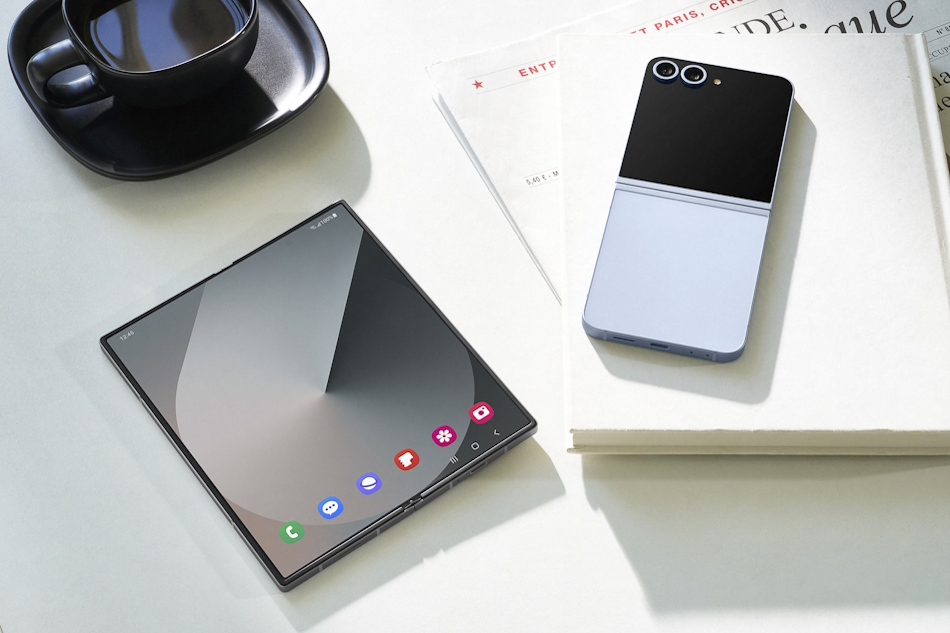
Connectivity includes 5G, and dual SIM is available in the form of one physical nanoSIM and a second eSIM card. In addition, there is Wi-Fi 6E and Bluetooth 5.3. The phone is available in gray, yellow, blue, and green; carbon black and white, complemented by orange, are also available on the manufacturer’s e-shop. The base model with 12/256GB costs €1,200 in Europe and $1,099 in the US, while the 12/512GB model is priced at €1,320 / $1,219.